
No. The obligation depends on whether the content appears realistic and authentic. A photorealistic image of a person, a place, or an event usually falls under this, while a distinctly comic-like illustration typically does not. However, in photorealistic advertising, you should not rely on exceptions.
Your TYPO3 website and the AI labeling obligation
As of August 2, 2026, the transparency obligations of the EU AI Regulation apply. Those who publish AI-generated images or texts must disclose this visibly in certain cases. The fine range goes up to 15 million euros or three percent of global annual sales — however, what is more practically relevant for most companies is something else: the Competition Authority has announced that it will pursue violations under competition law. Caution notices typically come faster than administrative procedures.
The good news: In many cases, the effort is manageable. The less good news: Without an inventory, you do not know which case applies to you.
What this means concretely for you
Not every AI image has to be labeled. This abbreviation is currently circulating through many posts and is simply incorrect. The obligation applies when you, as the operator of an AI system:
- ▪ publish image, audio, or video content that appears realistic. A photorealistic product image generated from the image generator falls under this. An obviously comic-style illustration usually does not.
- ▪ publish AI-generated texts on matters of public interest. There is an important exception here: If the text has been editorially reviewed and a person is responsible for it, the obligation falls away.
Internal content and the mere sharing or quoting of third-party AI content are not affected. And: Content created before August 2, 2026, does not need to be labeled retroactively.
We will clarify together where exactly the boundary lies in your case. Sometimes the result is: You don't have to do much. We will tell you that too.
Check Content Credentials
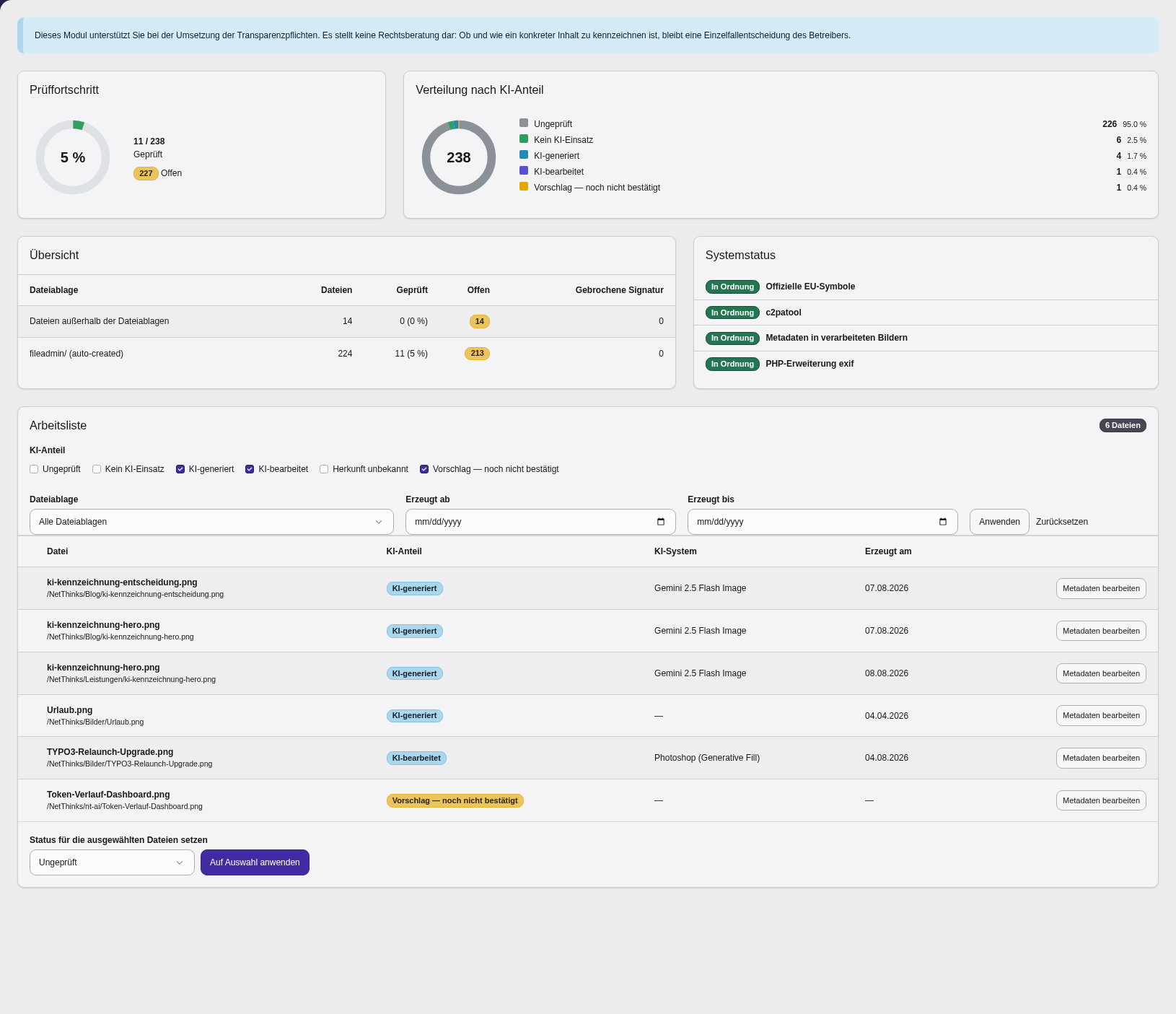
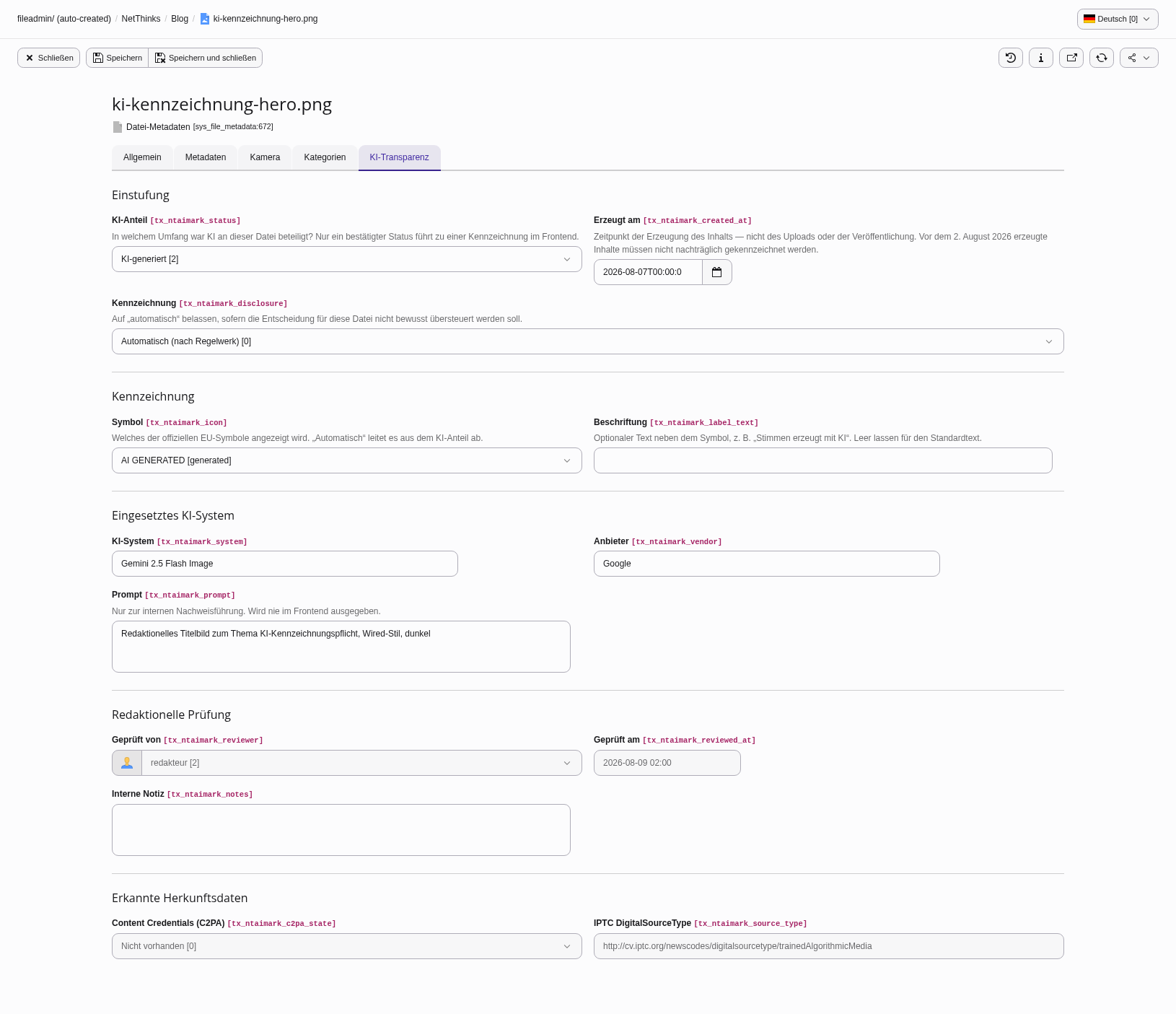
Serious AI tools write their origin into the file: Content Credentials according to the C2PA standard. This is a signed statement about what created an image and what was changed later. nt_aimark reads this and suggests a status — the decision is still made by your editorial team.
The reading is handled by an external tool, c2patool. It can be installed on a separate server in a few minutes. However, on managed hostings, it often fails due to a system library that is not intended there — regardless of TYPO3, and without any configuration adjustments.
The extension then continues without this one check: It bases recognition on XMP and EXIF data and marks the signature state as “not verifiable.” So, nothing is missing in the identification itself, but one of three sources for automatic recognition is absent.
For exactly this case, we are currently developing a verification service that handles the signature verification outside of your hosting — you don’t need to install anything there. It is not yet generally available. If this concerns your environment, contact us: We will tell you where we stand and whether the wait is worth it for you.
Our offer
KI-Transparenz-Audit
1.450 €
netto, einmalig
Wir sichten Ihre Website vollständig und liefern eine belastbare Grundlage:
- Bestandsaufnahme aller Medien und Texte mit KI-Anteil
- Einordnung, welche Inhalte kennzeichnungspflichtig sind — und welche nicht
- Konkreter Maßnahmenplan mit Aufwandsschätzung
- Dokumentation, die Sie im Fall der Fälle vorlegen können
- Abschlussgespräch mit Ihrem Team
Dauer: rund zwei Wochen ab Beauftragung.
Technische Umsetzung
ab 890 €
netto, einmalig
Wir installieren und konfigurieren unsere Extension nt_aimark in Ihrer TYPO3-Installation:
- Erfassung des KI-Status direkt in den Dateimetadaten — dort, wo Ihre Redaktion ohnehin arbeitet
- Automatische Erkennung vorhandener Herkunftsdaten beim Upload
- Barrierefreie Kennzeichnung im Frontend mit den offiziellen EU-Symbolen
- Aufklappbare Detailebene mit Angaben zum eingesetzten System
- Backend-Übersicht über geprüfte und offene Inhalte
- Zweistündige Redaktionsschulung inklusive
Laufende Betreuung
Als Baustein für Ihren bestehenden Wartungsvertrag: monatliche Prüfung auf ungekennzeichnete Inhalte, Anpassung an Änderungen der Rechtslage, Aktualisierung der Textbausteine.
ab 25 €
netto/Monat
Die Regulierung steht nicht still. Zum 2. Februar 2027 kommt die nächste Stufe. Wer das laufend mitführt, hat später keinen Nachholbedarf.
Alle Preise in Euro, zzgl. gesetzlicher Umsatzsteuer. Das Angebot richtet sich ausschließlich an Unternehmer im Sinne des § 14 BGB. „Ab“-Preise gelten für Standardinstallationen; der genaue Aufwand ergibt sich aus dem Bestand Ihrer Website und wird vorab schriftlich vereinbart.
Why NET.THINKS
We have been developing TYPO3 solutions for over 25 years and already have two extensions in productive use with nt-ai and nt-lingua that make AI usable directly in the TYPO3 backend. nt-aimark is the third in the group — and completes the circle: generate, translate, cleanly label.
If nt-ai or nt-lingua are in use at your site, AI-generated content is automatically captured. Your editorial team does not need to do anything additional.
You can read in advance what the extension does exactly — the complete documentation of nt_aimark is public: docs.netthinks.com/nt-aimark.
More about our AI extensions: AI for TYPO3 – Accessibility & Translation
Background on the legal situation: Since August, there has been a requirement for AI labeling — what this means for your website
Non-binding
Clarity in a conversation: Twenty minutes, non-binding. We will take a look at your website together, and you will know afterwards whether and to what extent you are affected.
Frequently Asked Questions
-
Do I have to label every image created by AI?
-
Do I need to retroactively label my existing content?
Basically no. Content created before August 2, 2026, is not covered by the obligation. The determining factor for images is the time of creation, not the publication.
-
Is it enough if I add a note in the imprint?
No. Disclosure must occur at the latest during the first contact with the content. A note in the imprint, in the terms and conditions, or at the end of a long text is expressly not sufficient.
-
Is an invisible technical marking in the image file sufficient?
Not for the operator obligation. The notice must be recognizable without special technical aids. Metadata alone is therefore not sufficient — a visible labeling is required.
-
Do I have to use the official EU symbols?
No, the use is voluntary. The symbols are a tool, not an obligation — and their use alone does not make you automatically compliant with the law. We still recommend them: They are free of charge, uniform across Europe, and your visitors will recognize them again.
-
What about AI-generated texts in our blog?
If a person has reviewed the text and a named individual is responsible for the editorial content, the obligation to label it is waived. However, you should be able to document this review — that is part of what our extension represents.
-
Does this affect me at all if I only use AI internally?
Pure internal content is not subject to the disclosure obligation under Article 50 paragraph 4. Once you publish, the picture changes.
Automatisch übersetzt. Ohne Gewähr für Vollständigkeit und Richtigkeit.