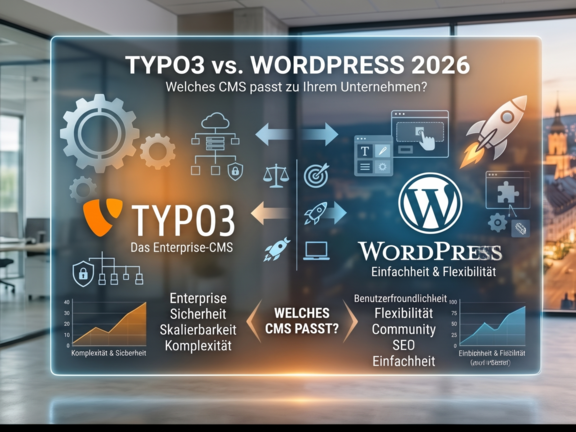
Neither system is universally “better.” TYPO3 is suitable for complex enterprise websites with multiple languages, editors, and subpages. WordPress is the better choice for small- to medium-sized websites where ease of use and a fast time-to-market are important. The decision depends on your specific requirements.
Category: CMS & Web Development | Reading time: about 8 minutes | Author: Dietmar Engler
Choosing the right content management system is one of the most important strategic decisions for your digital project. In German-speaking countries, the discussion usually centers on two systems: TYPO3 and WordPress. Both are open-source, both are based on PHP—and yet they could hardly be more different. We’ll provide an objective comparison to help you make the right decision.
Table of Contents
The Starting Point: Market Share and Positioning
WordPress dominates the global web: According to W3Techs, about 43% of all websites worldwide run on WordPress—which accounts for over 60% of all CMS-based sites. TYPO3 has a global market share of only about 0.4–1.2%, but it has a significantly stronger presence in the DACH region: In Germany, around 13% of all websites use TYPO3, primarily government agencies, universities, and larger companies.
Market share, however, is not an indicator of quality. The key question is: Which system best meets your needs?
User-Friendliness
WordPress stands out for its very short learning curve. The Gutenberg editor enables block-based editing that even non-technical editors can understand immediately. Since its introduction, Gutenberg has been actively used by over 80% of WordPress users.
TYPO3 is more technically demanding. The hierarchical site tree provides a clearer structure for websites with hundreds of subpages, but it requires training. Without experienced developers, it’s difficult to fully leverage TYPO3’s potential.
Conclusion: For editorial teams that need to maintain content independently, WordPress is the faster solution. TYPO3 is worth considering for large teams with clear IT support.
Security
Due to its widespread use, WordPress is the most frequently targeted CMS: 97% of all CMS attacks are directed at WordPress. The problem isn’t the core itself, but rather outdated or poorly maintained plugins—about 97% of all WordPress security vulnerabilities stem from third-party extensions.
Thanks to its structured core and lower market share, TYPO3 offers a smaller attack surface. However, both systems require regular updates and professional maintenance. An unmaintained TYPO3 is no more secure than a well-maintained WordPress.
Scalability & Multilingual Capabilities
This is where TYPO3 really shines: The system can easily manage 20 country-specific websites in dozens of languages from a single installation. Multi-site management and granular permission control for complex editorial teams are built into the core.
WordPress offers multilingual support via plugins such as WPML. This works reliably for two to five languages. With significantly more languages and separate markets, the administrative burden increases considerably.
Cost
WordPress is generally more cost-effective to purchase and maintain: the broad developer base, affordable hosting options, and managed WordPress packages reduce ongoing costs. TYPO3 requires specialized developers and longer project timelines, which increases effort and costs.
Our Recommendation
Not sure which CMS is right for your business? We offer free, vendor-neutral advice.
Frequently Asked Questions
-
Is TYPO3 better than WordPress?
-
Which CMS is less expensive to develop?
WordPress projects are generally more cost-effective and faster to implement, as there is a larger developer community and many features are available via plugins. TYPO3 requires specialized developers and longer project timelines, but in return offers greater flexibility and long-term stability for complex requirements.
-
Can I switch from WordPress to TYPO3?
Yes, it is possible to migrate from WordPress to TYPO3. Content, images, and URL structures can be transferred. We’ll advise you on whether a switch makes sense and plan the migration so that your ongoing operations are not disrupted.
-
For whom is WordPress the better choice?
WordPress is particularly well-suited for companies without their own IT department that want to manage their website on their own. It’s ideal for corporate websites, landing pages, and blogs—anywhere content needs to be updated quickly and easily.
Automatisch übersetzt. Ohne Gewähr für Vollständigkeit und Richtigkeit.