The Community Edition of Shopware 6 is available for free. For advanced features such as the B2B Suite, advanced automations, or dedicated functions, there are paid versions (Rise, Evolve, Beyond). In addition, there are agency and hosting costs for implementation and operation.
Category: E-commerce | Reading time: about 8 minutes | Author: Dietmar Engler
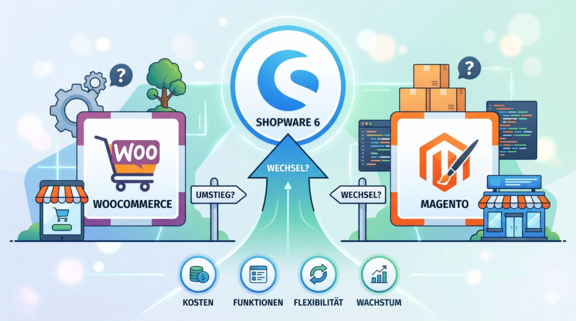
Online retail is growing—and so are the demands placed on e-commerce software. Those still relying on WooCommerce or Magento may be wondering: Is now the right time to switch? Over the past few years, Shopware 6 has evolved into one of the most powerful e-commerce platforms for German small and medium-sized businesses. We’ll show you who should make the switch—and who shouldn’t.
Table of Contents
Shopware 6 at a Glance
Shopware is a German company with over 20 years of experience in e-commerce. Version 6 was developed from the ground up and is based on modern technologies (Symfony, Vue.js). The platform has a modular structure, is designed with an API-first approach, and is available both as an open-source Community Edition and in commercial versions.
Key Features:
- Shopping Experiences: Drag-and-drop content design for product pages and landing pages
- Native multilingual and multi-currency support
- Powerful automation features (Flow Builder, Rule Builder)
- Headless-capable: Can be used as a backend for React/Next.js frontends
- Large and active German-speaking community
Shopware vs. WooCommerce
WooCommerce, as a WordPress plugin, is the most widely used e-commerce solution worldwide. It’s ideal for smaller stores with a clear focus on content marketing. The advantages: low upfront costs, a vast plugin ecosystem, and ease of use.
WooCommerce’s limitations become apparent when:
- The product catalog grows to several thousand items
- Complex variants, bundles, or customer-specific pricing are required
- Multiple sales channels (B2B, B2C, marketplaces) are operated in parallel
- Performance issues arise due to too many plugins
Recommendation: For up to about 500 items and a simple product structure, WooCommerce is often sufficient. Beyond that, consider Shopware.
Shopware vs. Magento
Magento (Adobe Commerce) has long been the gold standard for complex enterprise-level online stores. The platform is powerful, but also costly and heavily reliant on developers. Adobe Commerce (the commercial version) starts at several thousand euros per year—not including agency fees.
Shopware offers many comparable enterprise features with significantly lower upfront costs and better usability for store owners. For many medium-sized businesses, Shopware is now the more cost-effective alternative to Magento.
When is it worth making the switch?
Switching to Shopware 6 is particularly worthwhile if:
- Your current store is reaching its limits in terms of performance or functionality
- You’re planning a relaunch or a major overhaul anyway
- You need B2B functionalities (customer groups, custom price lists, order limits)
- You want to expand your multi-channel or international e-commerce operations
- You value a strong, German-speaking community and GDPR compliance
No switch is necessary if your current store is working well, you have no growth plans, and your requirements are stable. Switching platforms always involves costs and effort—it should pay off strategically.
Are you planning to launch an online store or relaunch your existing one? Together, we'll find the best solution.
Frequently Asked Questions
-
Is Shopware 6 free?
-
How long does a Shopware project take?
A basic online store can typically be set up in 6–10 weeks. Projects with specific requirements—such as ERP integration, product configurators, or multichannel setups—take longer. We’ll work with you to determine the exact timeline during the planning phase.
-
Can I migrate my existing store to Shopware?
Yes, it is possible to migrate from WooCommerce or Magento to Shopware. Product data, customer data, and order histories can be transferred using migration tools. We’ll analyze your existing store in advance and plan the migration so that operations can continue with minimal disruption.
Automatisch übersetzt. Ohne Gewähr für Vollständigkeit und Richtigkeit.